


The Enduring Voice of Nikolai Medtner: Life • Art • Legacy, Part 1
- Jul 9
- 5 min read
Updated: Jul 26
Part 1 — Life: Meeting Nikolai Medtner

"Medtner is the greatest composer of our time." — Sergei Rachmaninoff
How can a composer admired by generations of musicians remain outside the mainstream repertoire?
It is a question that surprises many listeners hearing the music of Nikolai Medtner (1880–1951) for the first time. Those who experience one of his piano sonatas or Fairy Tales often respond with the same sense of discovery: "Why have I never heard this before?"
The surprise is understandable. Medtner's music possesses the expressive warmth of the Russian Romantic tradition, the structural qualities of Beethoven and Brahms, and an unmistakably individual voice. Yet despite the admiration of many distinguished musicians—including his lifelong friend Sergei Rachmaninoff—his works have remained largely absent from mainstream concert life for much of the twentieth century.¹
This essay is the first in a three-part introduction exploring Medtner's life, music, and artistic philosophy. It begins not with the question of who Medtner was, but with a more intriguing one:
Who was Nikolai Medtner, and what continues to draw performers and listeners to his music today?
A Composer Between Two Worlds

Medtner was born in Moscow into a cultured family of German and Russian heritage.² His formative years coincided with one of the richest periods in Russian musical life. Tchaikovsky was at the height of his career, the Moscow Conservatory had become one of Europe's leading musical institutions, and a new generation of composers including Alexander Scriabin, Sergei Rachmaninoff, and later Igor Stravinsky would soon reshape the musical landscape.
Medtner belonged to this remarkable generation, yet he occupied a distinctive position within it.
Where many of his contemporaries sought new musical languages, Medtner devoted himself to expanding the expressive possibilities of an existing one. His compositional style was thoroughly Romantic, but his artistic ideals were rooted in a lineage extending from J.S. Bach through Beethoven and Brahms. Throughout his life he regarded these composers not as monuments of the past, but as living companions in an ongoing artistic tradition that each generation was called to inherit and extend.³
This commitment to continuity would become one of the defining features of both his music and his philosophy.
Beyond the Myth of the "Conservative"

Medtner is often described as a conservative composer.
The label is not entirely inaccurate, but it is incomplete.
To modern ears, "conservative" can suggest resistance to change or a reluctance to engage with new ideas. That was not Medtner's position. He did not reject innovation; he rejected the notion that novelty alone constituted artistic progress.
Writing in The Muse and the Fashion, his philosophical treatise published in 1935, Medtner argued that music possesses enduring principles that transcend the changing tastes of any particular era. Fashion, he believed, is temporary. The deeper laws of musical art are not.⁴
This conviction shaped every aspect of his compositional language.
His works are remarkable not because they overturn tradition, but because they reveal how much expressive possibility remained within it. A single motive may build an entire work. Inner voices assume structural importance. Harmonic richness grows organically from thematic development rather than decorative effect. These qualities make Medtner's music immediately recognizable, even while it remains firmly rooted in the tonal tradition.
His originality lies not in abandoning the past, but in extending it.
A Composer's Composer

If Medtner never achieved widespread fame, he nevertheless earned extraordinary respect among fellow musicians.
No advocate proved more devoted than Sergei Rachmaninoff.
The two composers first met in Moscow and remained close friends throughout their lives. Rachmaninoff performed Medtner's music, supported him financially during difficult years, and dedicated the revised version of his Fourth Piano Concerto to him in 1941.⁵ Their correspondence reveals a friendship founded not merely on personal affection but on profound artistic admiration.
Such esteem was not confined to Rachmaninoff alone. Musicians who encountered Medtner's scores frequently remarked upon their exceptional craftsmanship and intellectual depth. To performers, they offered inexhaustible possibilities for discovery; to listeners willing to engage deeply, they revealed an expressive world of remarkable richness.
Yet admiration among musicians does not always translate into public recognition.
A Voice Waiting to Be Heard
Such admiration among musicians naturally raises another question: why did Medtner never achieve the widespread recognition enjoyed by some of his contemporaries? The reasons were historical as much as musical, involving exile, changing artistic tastes, and the practical realities of concert life. These questions will be explored further in Part 3. For now, it is enough to observe that his music asks something unusual of its listeners.
Rather than seeking immediate effect, Medtner's music reveals its richness gradually, rewarding patient listening rather than instant admiration.
A Quiet Renaissance
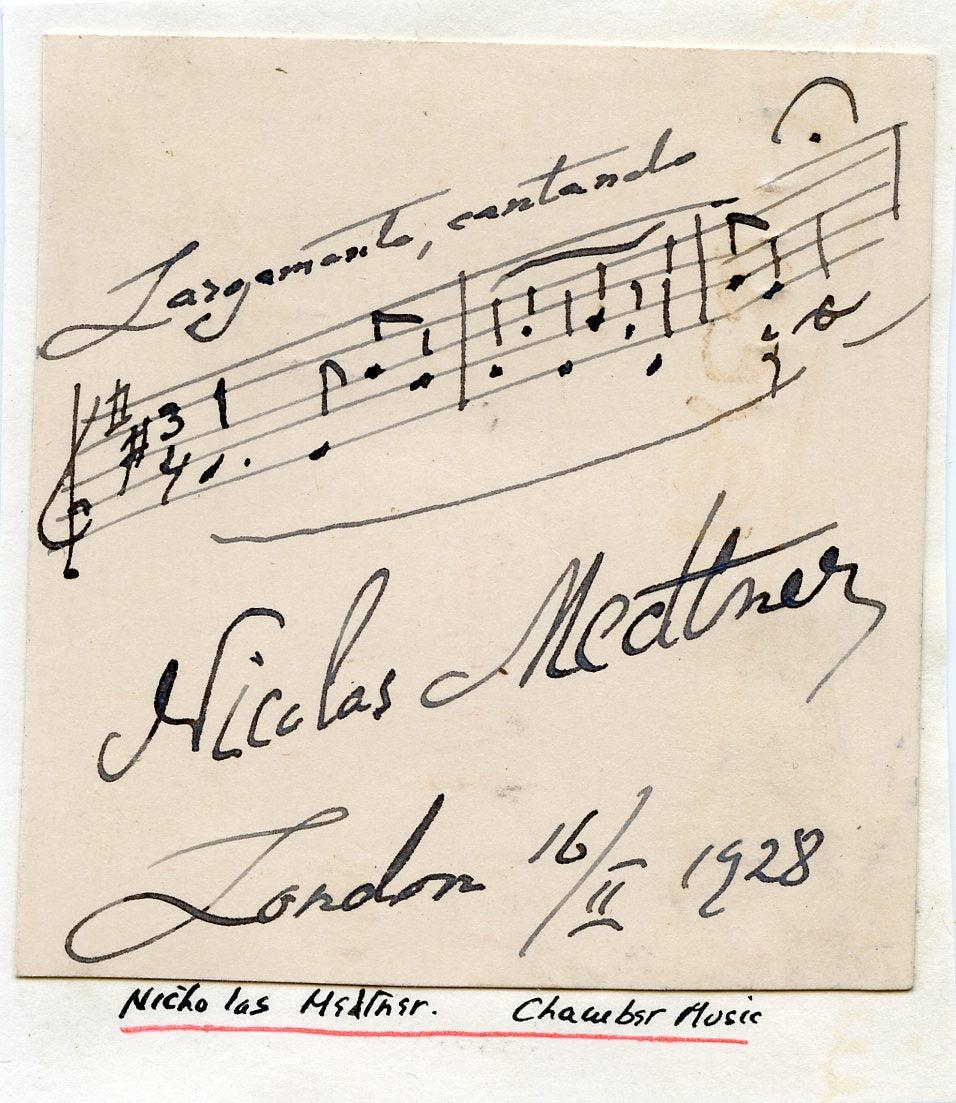
Yet many of the qualities that once limited Medtner's wider appeal have become among the reasons musicians value his work today. During the past several decades, Medtner's reputation has begun to change.
New scholarly editions, an increasing number of recordings, and the quiet dedication of performers, scholars, teachers, and listeners have introduced Medtner's music to a wider audience than at any time since his death in 1951. The complete piano sonatas have been recorded and studied. His Fairy Tales (Skazki) have become favorites among many pianists seeking repertoire beyond the familiar Romantic canon.⁷
This revival is still unfolding.
Unlike composers whose reputations have remained continuously secure, Medtner's audience continues to grow steadily as each generation receives his music and passes it on to the next. This ongoing revival offers more than an opportunity to reassess an overlooked composer. It offers an opportunity to hear his music on its own terms.
An Invitation
These essays are an invitation—not merely to learn about Medtner, but to encounter his music with fresh ears. The journey begins with the man, continues through the artist he became, and ultimately arrives at the enduring legacy that continues to inspire new generations of performers, scholars, and listeners. The best introduction to Medtner, however, is not found in these pages—it is found in the music itself.
Notes
Barrie Martyn, Medtner: His Life and Music (Aldershot: Scholar Press, 1995); Christoph Flamm, selected studies on Medtner's reception.
Martyn, Medtner, 1–18.
Medtner's reverence for the Austro-German classical tradition is discussed throughout The Muse and the Fashion and summarized in Martyn, Medtner, and Michael Allis, ed., The Piano Sonatas of Nikolai Medtner.
Nikolai Medtner, The Muse and the Fashion, trans. Alfred J. Swan (London: Hollen Street Press, 1951).
Geoffrey Norris, Rachmaninoff (New York: Schirmer Books, 1994); Martyn, Medtner, chapters on the Medtner–Rachmaninoff friendship.
Martyn, Medtner; Christoph Flamm, writings on Medtner's reception history.
Michael Allis, ed., The Piano Sonatas of Nikolai Medtner; Wendelin Bitzan, selected publications on Medtner performance and reception.


